Garage Door Repair: Repair or Replace? How West Hartford Homeowners Decide
A garage door company that immediately recommends full replacement on a ten-year-old door with a broken spring is either a poor diagnostician or is chasing a bigger ticket. Broken springs on a structurally sound door are almost always a repair, not a replacement trigger. The real decision comes down to four things: door age, how far panel damage spreads, the condition of the hardware, and what it would cost to bring the door back to full mechanical reliability. Here’s the actual framework, not a nudge toward the expensive option.
If you’d rather have a trained eye on it than guess from the driveway, call us at (855) 337-1712 and we’ll tell you straight which way it leans.
What’s the direct answer on repair vs. replace?
Repair a West Hartford garage door when the structure is sound and the problem is mechanical: a snapped spring, a bent track, a worn roller, an opener that’s lost its logic board. Replace it when the door itself has failed structurally, when damage spans several panels, or when the repair list has grown long enough that you’re funding a new door piece by piece. Age alone is not a reason to replace. A fifteen-year-old steel door with good panels and fresh hardware outlasts a cheap five-year-old door that’s been hit by a car twice.
Here’s the short version of the decision:
- Repair when one or two systems are down and the panels are straight and solid.
- Replace when panels are crushed, cracked, or separating, or when three or more systems need work at once.
- Get both numbers before you commit, then compare them on paper.
We work on the brand already in your garage, so a Craftsman opener that’s been limping for years doesn’t get treated like a mystery. We know how those older units fail and how to bring them back without replacing parts that don’t need replacing.
When is repair objectively the right call?
If the door goes up and down evenly and the panels are intact, the failure is almost always mechanical and repair wins on both cost and common sense. The door’s frame and skin are doing their job. What’s broken is the machinery that moves them, and machinery is meant to be serviced. A single broken spring, a frayed cable, a track knocked out of alignment by a bumper tap, rollers that have gone flat and noisy: these are all fixable without touching the door itself.
Some specific conditions where repair is clearly correct in West Hartford:
- The door is under fifteen years old and the panels are undamaged.
- The spring has failed but the door was opening smoothly right up until it didn’t.
- One panel is dented but the door still runs true and seals against the frame.
- The opener is the problem, not the door. LiftMaster and Chamberlain units especially are worth repairing; the motor and rail usually outlast the logic board by years.
Spring failure is a safety issue, not just an inconvenience. A torsion spring under load can injure someone badly if it’s handled wrong. That’s a job for a trained technician, full stop. We keep spring repair in our core lineup because it’s the highest-stakes job in the trade, and we’d rather you call us than improvise with a winding bar from the hardware store.
When is replacement genuinely justified?
Replacement earns its keep when the door has lost structural integrity or when the repair total climbs toward the cost of new. Both thresholds matter, and they’re measurable, which takes the guesswork out of it. A salesperson’s opinion is not a threshold. Panel condition and system count are.
Replacement is the honest answer when:
- Panels are crushed or cracked through. A cracked panel can’t be straightened. It can sometimes be swapped for a single matching section, but if two or more are damaged, the math shifts toward new.
- The bottom section is rotted or water-damaged. West Hartford’s freeze-thaw cycles punish the bottom panel first, where snow sits against it and melts and refreezes. Once that section is soft, the door loses its seal and its strength at the same time.
- Multiple systems need work at once. If the springs are gone, the opener is failing, the rollers are shot and the tracks are bent, you’re paying for a new door one invoice at a time. That’s the cumulative cost signal.
- The door is out of balance and can’t be brought back. A door that hangs crooked even after adjustment has a structural problem.
The cumulative rule of thumb we use: if the combined repair estimate lands above roughly half the cost of a comparable new door, replacement starts to make more sense, especially on a door past the fifteen-year mark. Below that line, repair wins. We’ll tell you which one makes sense, and we’ve got no reason to push the bigger number if the smaller one fixes it.
How do you assess panel damage: cosmetic or structural?
This is where most homeowners get talked into a new door they don’t need. A dent is cosmetic. A crack is structural. The difference is whether the panel can still carry its share of the door’s weight and seal against the weather. Cosmetic dents on a steel door are irrelevant to the repair decision and don’t affect how the door runs. A panel that’s cracked, bent out of plane, or separating from its frame changes the door’s geometry, and no amount of new hardware fixes a bent door.
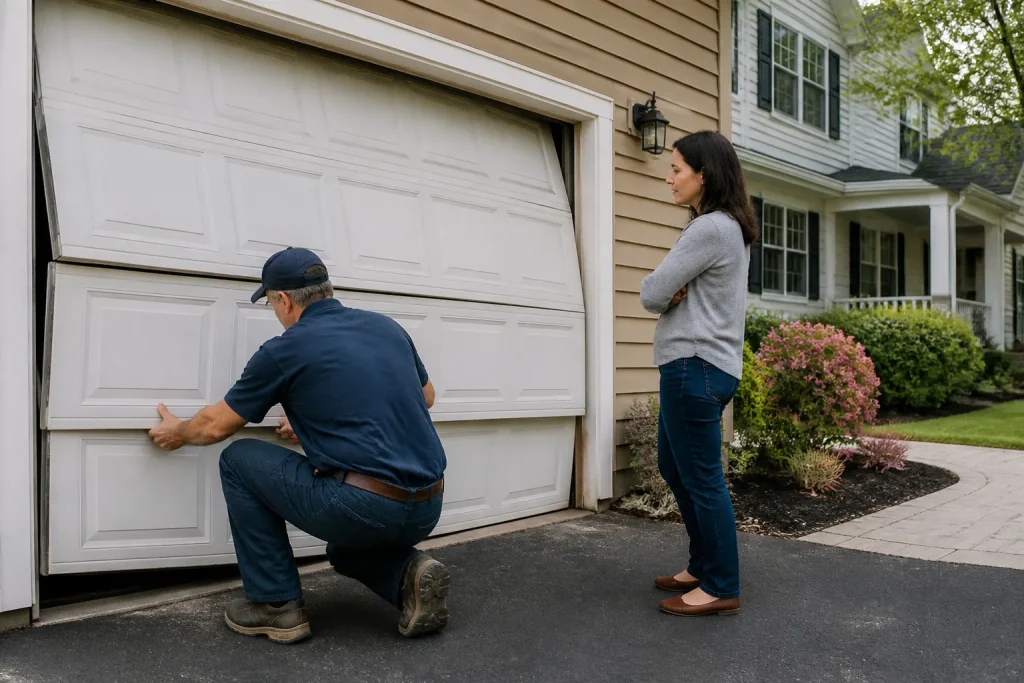
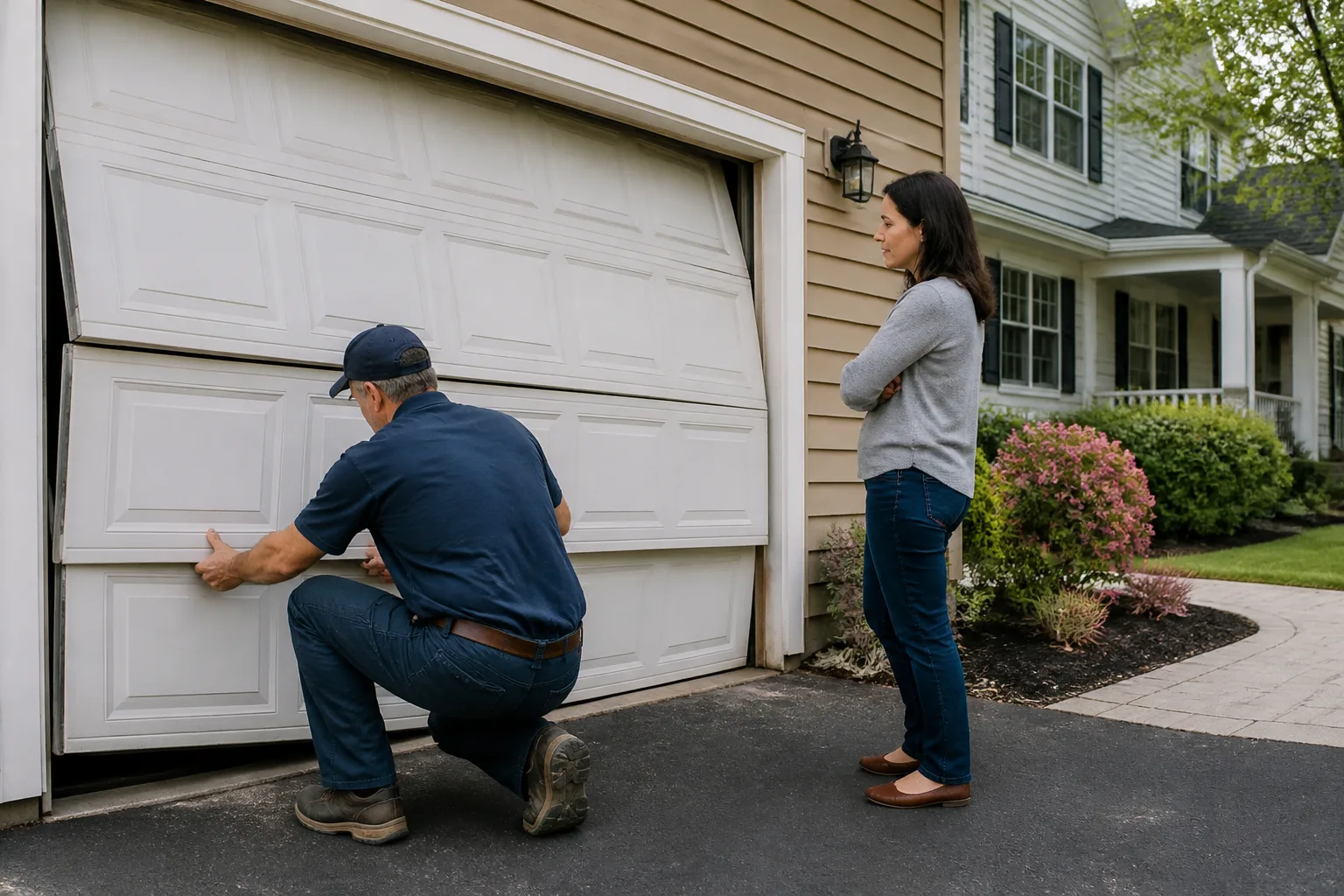
A quick way to judge it yourself: stand back and look at the door from the side, at an angle. If the panels line up in a flat plane, the structure is fine and any damage is cosmetic. If one panel sticks out or the door hangs like a crooked smile, the geometry is off and it needs a closer look. Also check the bottom section for softness, cracks, or separation where the panel meets the frame; that’s where West Hartford winters do their damage.
If you’re not sure which side of the line you’re on, that’s exactly the call to hand to a technician. Diagnosis is cheap; a misjudged replacement is not.
How does the West Hartford resale market factor in?
Buyers and inspectors in West Hartford notice a garage door that won’t close, won’t stay balanced, or looks visibly damaged. A door that runs smoothly and seals properly reads as a maintained home. A door with a bent track and a dangling spring reads as deferred maintenance, and buyers start adding up everything else they can’t see. A home inspector will test the door and note an opener that doesn’t reverse or a door that binds.
That doesn’t mean you replace a working door to impress a buyer. It means: if you’re selling in the next year or two, fix what’s broken so the door is mechanically sound and lines up clean. A straightened track and a new spring cost far less than the negotiating leverage a buyer gains from a door that won’t work. If the door is genuinely shot, a replacement before listing is a legitimate line item, but it needs to be justified by the same thresholds above, not by staging instinct.
How do you compare a repair estimate against a replacement quote?
Ask for both at the same visit and put them side by side. This is the single most useful thing you can do, and it removes the guesswork entirely. A repair estimate should list each item and its price. A replacement quote should itemize the door model and brand, the hardware package, removal and disposal of the old door, and installation labor. If it doesn’t break those out, ask why. A single lump sum tells you nothing about what you’re actually buying.
When you compare, do it on these lines:
- Scope. Does the repair estimate cover everything wrong, or just the most obvious failure?
- Brand and model. A replacement quote for Clopay or Amarr should name the exact series, not just “a steel door.”
- Hardware. New springs, rollers, and cables should be in the replacement quote. Don’t let old hardware get reused on a new door.
- Disposal and labor. Removal of the old door is real work. It should be a line item.
- What’s excluded. Ask directly. The written quote should be the full price, not a starting point.
We’ll quote both during the same visit so you’re comparing real numbers, not a guess against a guess. The price is agreed before any work starts. That’s the rule we work by, and it answers the biggest fear after the breakdown itself: an invoice bigger than the quote.
When to call a pro
The repair-or-replace call is one you can make yourself with the framework above. The work that follows is not always one you should make yourself. Springs under tension, cables under load, and openers tied into household wiring are jobs where a mistake costs more than a service call. If you’ve got a snapped spring, a door that hangs crooked, a cable that’s frayed, or an opener that’s dead, that’s the point to hand it off.
Our technicians have up to 15 years of experience and are certified to work on the eight brands we service, so the person who shows up knows the system in front of them rather than guessing at parts. Emergency garage door service is a real part of what we do, because doors don’t fail on a convenient schedule.
Related services in West Hartford: garage door repair for mechanical failures and panel work, garage door spring repair when a spring has let go, and garage door opener repair for a LiftMaster, Chamberlain, Genie, or Craftsman unit that’s quit on you. If you’re weighing a new door against a repair, that’s where we come out to measure and quote. Everything in one place, so nothing gets handed off to a second company.
The Bottom Line
Repair wins when the door is structurally sound and the problem is mechanical. Replace when the panels have failed, damage is widespread, or the repair total climbs past roughly half the cost of a new door on an older unit. Get both numbers, compare them line by line, and demand an itemized quote on the replacement side. Age alone is never the deciding factor. The door’s condition and what it costs to make it reliable are.
Most of the time the honest answer is the repair, and that’s fine by us. Knowing the right part for your specific opener model and skipping the parts you don’t need is better work than a bigger invoice. If you’re in West Hartford and need help, West Hartford Garage Door Repair Pros offers free estimates with upfront pricing. Call (855) 337-1712 and we’ll walk you through it. You can also start at West Hartford Garage Door Repair Pros and see what else we handle.
Frequently Asked Questions
No. A broken spring on a structurally sound ten-year-old door is a repair, not a replacement trigger. If the panels are straight and the hardware is otherwise in good shape, a spring replacement restores the door and costs far less than new. We’d only look at replacement if the panels are also damaged or several systems have failed together.
Cosmetic damage is a dent that doesn’t change how the door runs or seals. Structural damage is a crack, a panel bent out of plane, or separation from the frame. If the door still lines up flat when you look at it from an angle and seals against the frame, the damage is cosmetic and irrelevant to the repair decision.
When the combined repair estimate reaches roughly half the cost of a comparable new door, and the door is past about fifteen years old, replacement usually makes more sense. Below that line, repair is the better call. The exact number depends on the door and the scope, which is why we quote both during the same visit.
Yes, and you should. Ask for both during one visit and put them side by side. A replacement quote should itemize the door model and brand, the hardware, removal and disposal, and installation labor. If it’s a single lump sum, ask for the breakdown before you decide. Call (855) 337-1712 for a free estimate.
Written by the team at West Hartford Garage Door Repair Pros.
Need Garage Door Help?
Call West Hartford Garage Door Repair Pros - the local pro we connect you with is licensed and insured, here with fast after-hours help in West Hartford.
(855) 337-1712